
SEMG Hand Gesture Classification for Transradial Amputees
Classification of Hand Gestures using SEMG Signals with Force Variation for Transradial Amputees
Arindam Dev, Md. Fazle Elahi, M. M. Harun-Ur-Rashid.
Department of EEE, Bangladesh University of Engineering and Technology (BUET)
Overview
A pattern recognition based method for classifying 6 hand gestures from surface EMG (SEMG) signals of transradial amputees, robust to force level variation. The method proposes a novel orientation-based feature set and a channel selection algorithm using Recursive Feature Elimination (RFE), achieving state-of-the-art accuracy with an SVM classifier.
Key Contributions
- Novel orientation-based feature set — less sensitive to force level variation than raw features
- Channel selection via RFE — reduces channels from 12 to optimal 5, improving accuracy by 3.2% over sequential selection
- High accuracy at all force levels — especially at high force where prior methods degrade significantly
- Validated on a public benchmark dataset of 9 transradial amputees
Dataset
| Property | Details |
|---|---|
| Source | Khushaba EMG Repository |
| Subjects | 9 transradial amputees (TR1–TR7, CG1, CG2) |
| Gestures | Index flexion, Thumb flexion, Fine pinch, Tripod grip, Hook grip, Spherical grip 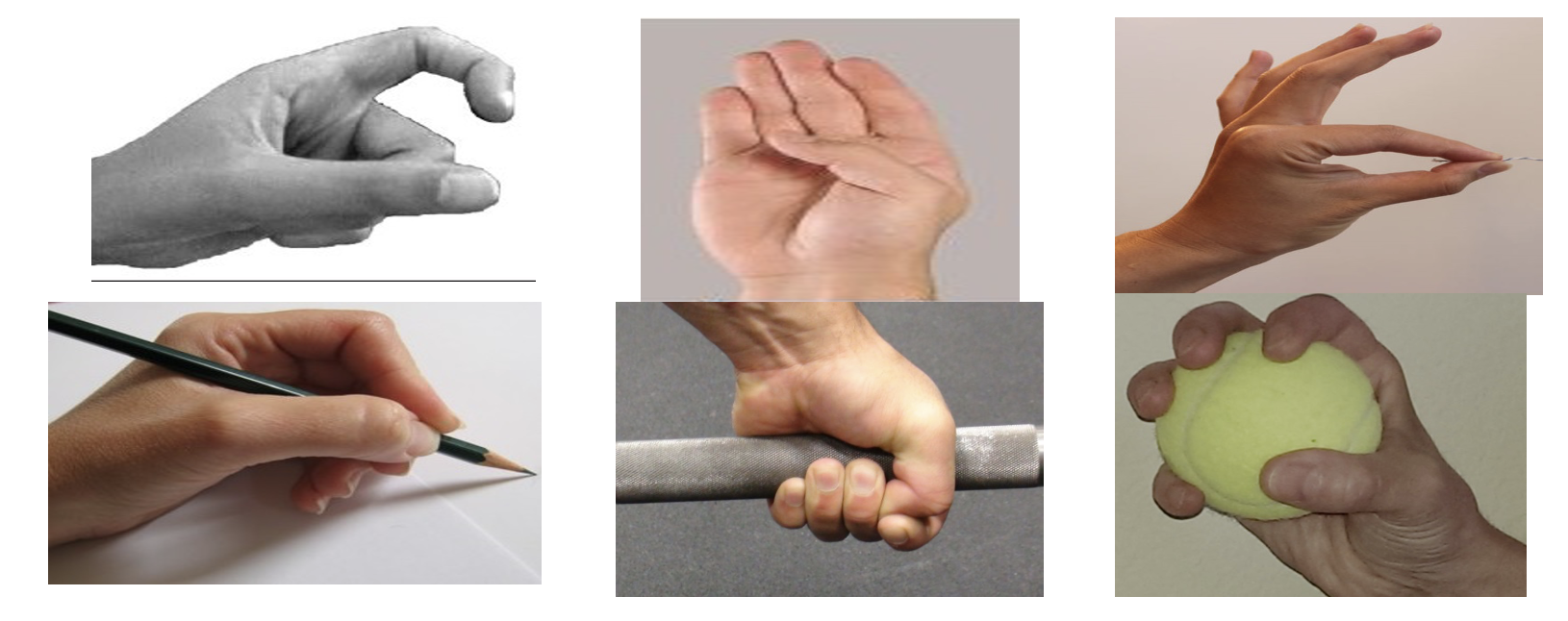 |
| Force Levels | Low, Medium, High |
| Sampling Rate | 2 kHz |
| Channels | 8–12 per subject |
Methodology
Raw SEMG Signal
      │
      ▼
┌─────────────────────┐
│   Feature Extraction │  ← m0, μ2, μ4, SSC, DASDV, MAV (from raw + log-mapped signal)
└─────────────────────┘
      │
      ▼
┌─────────────────────┐
│ Orientation Features │  fi = -2*ai*bi / (ai² + bi²)
└─────────────────────┘
      │
      ▼
┌─────────────────────┐
│  Channel Selection   │  ← Recursive Feature Elimination (RFE) → top 5 channels
└─────────────────────┘
      │
      ▼
┌─────────────────────┐
│   SVM (RBF Kernel)  │  ← One-vs-All multiclass, grid search for C & γ
└─────────────────────┘
      │
      ▼
   6-Class Gesture Output
Features Extracted
| Feature | Symbol | Type |
|---|---|---|
| Root square zero-order moment | m₀ | Frequency (via Parseval’s) |
| Second-order central moment | μ₂ | Time domain |
| Fourth-order central moment | μ₄ | Time domain |
| Slope sign change | SSC | Time domain |
| Diff. absolute standard deviation | DASDV | Time domain |
| Mean absolute value | MAV | Time domain |
All features are power-normalized (λ = 0.2) and extracted from both raw signal x and log(x²), then combined using the orientation formula.
Results
Accuracy vs Number of Channels
| Channels | Low FL | Medium FL | High FL | All FL | Time/Segment |
|---|---|---|---|---|---|
| 4 | 93.8% | 93.1% | 88.9% | 92.3% | 2.62 ms |
| 5 | 95.3% | 94.8% | 90.2% | 93.5% | 2.79 ms |
| 6 | 96.6% | 96.4% | 91.2% | 95.1% | 2.95 ms |
| 8 | 97.6% | 97.3% | 93.0% | 96.2% | 4.03 ms |
✅ 5 channels selected as optimal — best accuracy-to-speed tradeoff.
Comparison with State-of-the-Art (5 channels each)
| Method | Low FL | Medium FL | High FL | All FL |
|---|---|---|---|---|
| Proposed | 95.3% | 94.8% | 90.2% | 93.7% |
| TD-PSD [Al-Timemy 2016] | 89.6% | 87.5% | 80.1% | 86.3% |
| TD Features [Al-Timemy 2013] | 81.8% | 80.3% | 71.8% | 78.6% |
| Combined [He 2015] | 92.4% | 91.8% | 79.5% | 88.4% |
Statistical Validation
- Kruskal-Wallis test confirms features significantly discriminate gestures (p < 0.05 for all 6 features)
- Cohen’s Kappa: κ = 0.9447 (Low), 0.9378 (Medium), 0.8822 (High) — strong classifier agreement
Tech Stack



Acknowledgements
Supervised by Dr. Mohammed Imamul Hassan Bhuiyan, Professor, Department of EEE, BUET.
Dataset provided by Rami Khushaba’s EMG Repository.